
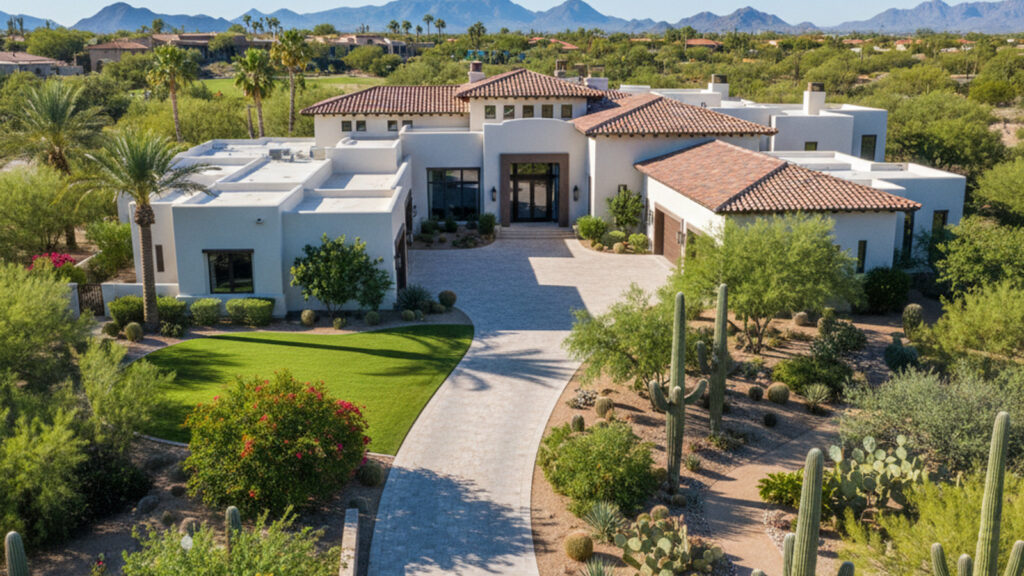
The median home price in Paradise Valley, AZ hovers around $4.6 million to $4.8 million in early 2026, while neighboring Scottsdale, AZ sits closer to the $850,000 to $1,000,000 mark. These two Maricopa County municipalities border each other directly, yet they offer completely different real estate environments. Buyers comparing Scottsdale vs. Paradise Valley, AZ will find that the choice comes down to lot size requirements, zoning laws, and access to commercial development.
Scottsdale covers 184 square miles of terrain stretching from the urban core up into the high desert. Paradise Valley occupies just 15 square miles entirely surrounded by Phoenix and Scottsdale. Understanding how local zoning shapes the housing inventory in each city helps buyers narrow down their search parameters.
Comparing Home Prices and Property Types
Paradise Valley enforces a one-acre minimum lot size for the vast majority of its residential properties. This zoning law prevents high-density development and limits the available inventory to large luxury estates. Buyers looking for smaller footprints, townhomes, or condominiums will not find those options within the Town of Paradise Valley.
Scottsdale offers a wider range of housing styles across its distinct neighborhoods. Central and South Scottsdale feature mid-century single-family homes, luxury condominiums, and newly built townhomes. Moving north into areas like DC Ranch, Silverleaf, and toward the Cave Creek, AZ border, the market shifts toward master-planned gated communities with larger custom homes.
The sheer size difference between the two cities translates directly to available inventory. Scottsdale consistently lists hundreds of properties across multiple price brackets at any given time. Paradise Valley maintains a much smaller pool of active listings, often requiring buyers to move quickly when a property matching their criteria hits the market.
Zoning Rules and Access to Local Amenities
The Town of Paradise Valley operates almost exclusively as a residential municipality. Local zoning laws prohibit traditional commercial shopping centers and large retail hubs within town limits. Residents rely on nearby resort properties, such as the Camelback Golf Club, for immediate dining and recreation options.
Scottsdale embraces mixed-use development and maintains massive commercial zones. The city serves as a regional destination for retail, anchored by Scottsdale Fashion Square and the dense restaurant scene in Old Town Scottsdale. Buyers who want immediate, walkable access to dining and nightlife often focus their search here.
Because Paradise Valley shares borders with both Phoenix and Scottsdale, residents are never far from these commercial hubs. The lack of internal retail simply preserves the low-traffic, low-density environment that defines the town. Buyers should weigh their preference for immediate retail access against the quiet streetscapes of a purely residential enclave.
Calculating Property Taxes and Carrying Costs
Maricopa County assesses property taxes for both municipalities, but the effective rates differ depending on the local jurisdiction. In early 2026, the effective property tax rate in Paradise Valley sits around 0.33%. Scottsdale properties generally see an effective rate between 0.44% and 0.48%.
While the percentage is lower in Paradise Valley, the higher median home values result in larger annual tax bills. A $4.8 million estate in Paradise Valley generates a much higher property tax obligation than a $1 million home in Scottsdale. Buyers should calculate these carrying costs alongside their monthly mortgage payments.
Homeowners associations also play a role in the total carrying costs for both cities. Many master-planned communities in North Scottsdale charge monthly HOA dues to maintain private roads, community centers, and guard gates. Paradise Valley properties are less likely to fall under an HOA, though some private enclaves do exist.
Commute Times to Phoenix and Sky Harbor
Drive times into central Phoenix depend primarily on which part of the region you choose. The Loop 101 and AZ-51 serve as the main arteries connecting these areas to the broader Phoenix metropolitan area.
Location impacts daily travel times for work and airport access. Buyers commuting to downtown or the Biltmore Estate area often compare the following routes:
- Paradise Valley to Phoenix Sky Harbor International Airport: The drive typically takes 15 to 20 minutes using AZ-51.
- South Scottsdale to Downtown Phoenix: Commuters generally spend 20 to 25 minutes on the road via the Loop 202.
- North Scottsdale to Sky Harbor: Residents in the northern zip codes should plan for a 30 to 40-minute drive down the Loop 101.
Buyers prioritizing short commutes to the airport or downtown Phoenix often prefer Paradise Valley or the southern zip codes of Scottsdale. Those who work remotely or commute within the northern tech corridors find the longer drive times from North Scottsdale acceptable.
Local School Districts and Trail Access
Two primary public school systems serve the region: the Scottsdale Unified School District and the Paradise Valley Unified School District. The boundaries for these districts do not exactly align with the city limits. Some homes in Scottsdale fall within the Paradise Valley Unified School District, so buyers should verify the specific assignments for any property they consider.
Access to outdoor recreation shapes the lifestyle in both cities. Scottsdale manages the McDowell Sonoran Preserve, which provides hundreds of miles of protected trails for hiking and mountain biking. This preserve covers a massive portion of the city’s northern geography.
Paradise Valley residents live adjacent to some of the most recognized natural landmarks in Arizona. The town surrounds Mummy Mountain and sits right next to the Echo Canyon Trailhead at Camelback Mountain. These central locations provide immediate trail access without requiring a drive to the urban outskirts.
Frequently Asked Questions
Which is more expensive, Scottsdale or Paradise Valley?
Paradise Valley commands higher prices, with median values near $4.6 million compared to Scottsdale’s $850,000 average. The town’s local zoning laws mandate large lots, preventing the construction of entry-level housing. This restriction keeps the baseline entry price well above the rest of Maricopa County.
Does Paradise Valley have commercial shopping centers?
No, the town does not zone for large-scale retail or mixed-use developments. Residents drive into neighboring Phoenix or Scottsdale for groceries, luxury shopping, and dining. The local commercial footprint is limited to a few luxury resort properties and their affiliated restaurants.
How do property taxes compare between the two?
Paradise Valley offers a lower effective tax rate of roughly 0.33%, while Scottsdale ranges from 0.44% to 0.48%. However, because the assessed property values in Paradise Valley are much higher, the actual dollar amount paid annually is usually larger. Buyers should run the exact numbers on individual parcels before making an offer.